Your Immigration Guide
Simple visa and Immigration guides without legal jargon
Simple visa and Immigration guides without legal jargon
Back to All Resources
Learn about the many kinds of U.S. work visas, who qualifies for them, and how each one works.
 David A. Keller, Esq.
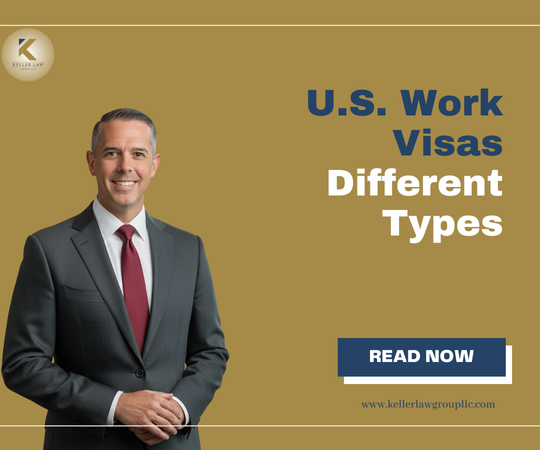
The United States offers a wide range of work visa options for foreign nationals. Understanding their purpose, eligibility requirements, and duration of stay can help you find the right path for your employment or long-term residency goals.
A U.S. work visa gives a foreign national the ability to live and work in the U.S. There are two types of work visas:
Intent is the key difference between immigrant and nonimmigrant work visas. Immigrant work visas are designed for foreign nationals who want to obtain permanent residency in the U.S. They usually offer a pathway towards a Green Card. Most nonimmigrant work visas do not offer that option, unless they permit dual intent, and some have stricter requirements around duration of stay.
However, many future permanent residents or even naturalized citizens begin their immigration journey through nonimmigrant work visas.
Temporary U.S. work visas are designed for temporary work in the United States. Some visas allow you to stay for a few weeks, while others allow you to stay for many years and pursue permanent residency.
The E-1 and E-2 visas target traders and investors coming to the U.S. temporarily for commercial business. These visas don’t require you to have a sponsor, but they do require a qualifying business that is owned by members of a treaty country and is actively operating in the U.S. This can include conducting trade in goods or services, managing investments, or consulting company operations.
E-3 visas are different, as they specifically target Australians working in specialized industries. E-3 applicants must obtain a sponsor who will submit a Labor Condition Application (LCA) for them, which essentially says there are no U.S. workers who can do their job.
All three E visa categories can bring along their spouses and children under 21 as dependents under E status.
H visas are one of the most popular temporary work authorization pathways for foreign nationals. Depending on the subcategory, these visas allow specialized and agricultural professionals to have jobs in the U.S. Some H visas permit dual intent, meaning they allow holders to pursue a Green Card.
The H visa category includes the:
Tip: Did you know? There are several alternatives to the H-1B visa that don’t have a yearly cap or lottery. Some even allow you to work for multiple employers or start a business in the U.S.
These visas are specifically designed for foreign media workers looking to report in the U.S. As long as they continue reporting for their respective media company, they can continue to remain in the U.S.
L visas are for intracompany transfers, which allow multinational companies to bring foreign employees to the U.S. to work in a managerial/executive role (L-1A) or specialized knowledge role (L-1B). These visas can allow dual intent and can be a pathway to permanent residency for eligible applicants.
O visas are designed for people with extraordinary ability or achievement in the sciences, arts, education, business, athletics, or the motion picture/television industries. Applicants must show sustained acclaim and meet specific evidentiary criteria.
P visas cover certain athletes, entertainers, and artists coming to the U.S. temporarily to perform at specific events or as part of an internationally recognized group. Subcategories differ based on the nature of the performance and eligibility criteria.
R-1 visas allow religious workers to come to the U.S. temporarily to work for a non-profit religious organization. These visas are dual intent, meaning holders can request a Green Card without it affecting their R-1 status. R-1 holders can also petition for their dependents to accompany them on the R-2 visa.
Thanks to the United States-Mexico-Canada Agreement (previously known as NAFTA), Canadian and Mexican citizens in certain professions can obtain a TN visa to work in the U.S. The TN’s initial stay period can last up to three years, and can be extended indefinitely. TN visa holders can also sponsor spouses and children under 21 under the TD status.
Unlike most nonimmigrant visas, the following work visa categories offer direct pathways to permanent residency in the United States. USCIS gives priority to the most highly skilled workers, which means those pursuing an EB-1 Green Card are more likely to get it faster than those applying for an EB-4 Green Card, for example.
The EB-1 category is generally reserved for workers with extraordinary ability, outstanding professors and researchers, or multinational managers and executives. It typically carries strong evidentiary requirements and can be a faster route for eligible applicants.
The EB-2 category is often for professionals with advanced degrees or individuals with exceptional ability. Some EB-2 applicants may qualify for a National Interest Waiver depending on the nature of their work and its benefit to the U.S.
The EB-3 category generally includes skilled workers, professionals, and other (unskilled) workers. This category often requires employer sponsorship and, in many cases, a labor certification process.
The EB-4 category encompasses special workers not covered under EB-1, EB-2, or EB-3. These can include religious workers or foreign members of the U.S. military.
The EB-5 category is an investment-based pathway to permanent residency. Eligible applicants generally must make a qualifying investment and meet job-creation requirements under the applicable rules and thresholds.
Some travel classifications allow business-related visits to the U.S. for limited durations. These do not grant work authorization for a U.S. employer.
B-1 status is typically used for business visitor activities such as meetings, conferences, and certain professional engagements, depending on the facts. It’s important to remember that B-1 status does not grant work authorization. Meaning, you cannot work for any U.S. employer under this visa.
Depending on your nationality, you may be able to enter the U.S. for up to 90 days without a visa. Much like the B-1, the Visa Waiver Program (VWP) allows nationals to conduct business-related events. However, they do not provide work authorization for a U.S. employer.
These visas are primarily targeted towards educational or vocational programs, but many of them do allow work authorization.
F visas are for academic students enrolled in qualifying U.S. institutions. Many F-1 students can pursue limited employment authorization under specific rules (for example, on-campus work and certain practical training options) depending on eligibility.
J visas cover exchange visitors participating in approved programs (including interns, trainees, scholars, and others). Work authorization depends on the program category and sponsor rules, and certain J holders may be subject to additional requirements depending on their circumstances.
M visas are for vocational students in qualifying programs. Work authorization is more limited compared to certain other student classifications and depends on applicable rules and approvals.
Q visas are related to certain international cultural exchange programs that involve practical training and employment while sharing the applicant’s culture. Eligibility and program requirements are specific to the classification.
Selecting the right work visa requires a clear understanding of the available immigration options. This guide is designed to help you feel more confident in identifying the visa pathway that aligns with your professional goals and personal circumstances.
If you are unsure which work visa category is the best fit for your situation, Keller Law Group LLC can help. Our team connects you with an immigration attorney experienced in your specific case type. Request a consultation today to take the next step forward.
Request an evaluation
Schedule Your Free Discovery Call
Take the first step toward resolving your legal challenges. Book a friendly meet-and-greet to get to know each other (no legal advice at this stage). However, if you’re ready for tailored guidance, schedule a direct legal consultation instead.
We’re here to support you every step of the way!
Get in Touch with Us
300 Main Street, 1st Floor Worcester, MA 01608

Monday - Friday | 9AM to 5PM
Saturday | Appointment Only
Sunday | Closed
Disclaimer:
In accordance with rules established by the Supreme Judicial Court of Massachusetts, this site must be labeled “advertising.” It is designed to provide general information for clients and those browsing our firm’s website and should not be construed as legal advice, or legal opinion on any specific facts or circumstances. This website is designed for general information only. The information presented at this site should not be construed to be formal legal advice nor the formation of a lawyer/client relationship.



Powered by AG InfoTech