Your Immigration Guide
Simple visa and Immigration guides without legal jargon
Simple visa and Immigration guides without legal jargon
Back to All Resources
The K-1 visa, also called the Fiancé(e) visa, is for U.S. citizens intending to bring their foreign fiancé(e) to the United States for marriage. In this comprehensive guide, we walk you through the K1 visa process, eligibility requirements, types of evidence to prove your relationship, and how to prepare for the interview.
 David A. Keller, Esq.
The K-1 visa, also known as the Fiancé(e) visa, is a visa designed for U.S. citizens who plan to bring their foreign fiancé(e) to the US for marriage. This visa allows the fiancé(e) to enter the U.S. for up to 90 days for the purposes of getting married. Once married, the foreign spouse can apply for a Green Card .
The K-1 visa is a good option for couples who wish to build a life together in the U.S. and would like to get married in the US and not overseas.
Let’s take a look at some of the key K1 visa benefits:
Path to permanent residency : With the K1 visa, the foreign fiancé(e) will receive a conditional green card . After two years, you will need to file a joint petition to remove these conditions, securing a permanent green card upon approval.
Temporary visit: The K-1 visa allows the fiancé(e) to stay in the U.S. for up to 90 days, during which they can tie the knot.
Legal status : The K-1 visa also grants the foreign fiancé(e) legal permission to reside in the United States while preparing for marriage and following immigration procedures.
Tip: In fiscal year 2023, there were 19,825 K1 visas that got approved! According to data from Track My Visa Now , 30% of applications received an RFE and 59.7% of those RFE cases were approved.
If you're considering the K1 fiancé(e) visa, it's important to understand the eligibility requirements. As mentioned, this visa allows a U.S. citizen to sponsor their foreign partner's legal entry into the United States for marriage.
Both you and your fiancé(e) must be ready to tie the knot within 90 days of their arrival in the U.S. And, it's all about genuine commitment – your relationship should be about building a life together, not just for immigration purposes.
Let’s take a look at what you both need to qualify for the K1 visa.
Legal Eligibility : The sponsor needs to be a U.S. citizen and legally eligible to marry. That means they can't already be married when filing the petition
Financial Ability : The sponsor will need to show that they can financially support the fiancé(e) and make sure they won't rely on public assistance in the U.S. (We’ll cover these requirements in the following section)
Intent to Marry: It's essential that there is a genuine intention to marry the fiancé(e) within 90 days of their arrival in the U.S.
No Violations: The visa sponsor must have a clean record – no visa or immigration violations, criminal convictions, or disqualifying factors.
Tip: Before applying for a K1 visa, make sure you're officially divorced if you've been married before. We've had clients who were surprised to find out during the application process that they were still legally married or that their divorce paperwork wasn't done right. It's best to double-check to avoid any complications later on.
Legal Eligibility: The fiancé(e) needs to be legally free to marry, meaning they're not currently married to someone else and have any previous marriages that have ended legally.
Health Requirements: The fiancé(e) must pass a medical examination by an approved doctor to make sure they meet the health standards for entering the U.S.
Intent to Marry: Just like the sponsor, the fiancé(e) needs to genuinely intend to get married within 90 days of their arrival in the U.S.
No Violations: The fiancé(e) shouldn't have any issues that would make them inadmissible to the United States, like a criminal record, health problems, or previous immigration violations.
While there's no set income amount required to sponsor a K-1 visa, the sponsor needs to earn at least 125% of the U.S. Federal Poverty Guidelines for their household size.
If you're looking to sponsor your fiancé(e) and you're a household of two (you and your fiancé), you'll typically need to have an income of at least $25,550. However, if you're in the military, you might need to meet a slightly lower income threshold, usually around 100% of the Federal Poverty Guidelines.
Check out the chart below to see the K1 visa income requirements for 2024, by household size:
Household Size, # people
2
3
4
5
6
7
8
100% of HHS Poverty Guidelines
Active duty U.S. armed forces
$20,440
$25,820
$31,200
$36,580
$41,960
$47,340
$52,720
+$5,380 for each additional person
125% of HHS Poverty Guidelines
All other sponsors
$25,550
$32,275
$39,000
$45,725
$52,450
$59,175
$65,900
+$6,725 for each additional person
If you live in Alaska or Hawaii, where the cost of living is higher, you'll need to meet different income requirements. For a household of two people, it's $31,925 in Alaska and $29,375 in Hawaii. Additionally, for each extra person, you'll need $8,413 in Alaska and $7,738 in Hawaii.
If the sponsor's income is below this level, they might be able to use assets or have a joint sponsor to meet the requirement. Remember, specific income criteria can vary based on your situation, so it's best to check with the U.S. Citizenship and Immigration Services (USCIS) for the most accurate information.
Two of the most important requirements of the K1 visa are proving the legitimacy of your relationship and satisfying the “2-year rule”.
First, you'll need to show evidence demonstrating a genuine and committed connection between you and your fiance(e). Evidence can include …
Photographs of you as a couple
Records of communication like emails, texts, phone calls
Screenshots of social media interactions
Travel itineraries for trips taken together
Support letters from friends and family confirming the relationship
Joint bank account statements
Shared rental agreements or bills
Evidence of joint purchases
Next, you’ll need to meet the 2-year rule for a K-1 visa.
The 2-year rule for the K1 visa requires that you and your fiance(e) must have met face-to-face at least once in the two years before applying for the K1 visa.
This rule is designed to ensure that the relationship is genuine and not solely based on virtual communication. However, there are certain exceptions to this rule – for instance, if meeting in person isn't possible due to cultural or religious reasons, or if it would be extremely difficult for you both.
You will need to submit evidence of your meeting, like showing flight bookings, hotel itineraries, pictures, or messages exchanged.
Tip: You can get a 2-year rule exemption for a K1 visa if your religion or culture prohibits in-person meetings prior to marriage. Contact a Keller Law attorney to learn more.
Kevin and Sarah
Kevin, a U.S. citizen, and Sarah, his fiancée from Canada, have been in a long-distance relationship for over two years. To prove the authenticity of their relationship, they include copies of Whatsapp messages exchanged daily – talking about their future plans to get married, providing emotional support, and expressing their love.
They also submit a collection of photos from two of their recent travels together, some including photos of them with each other's parents.
Keller Law©️
David and Maria
David, a U.S. citizen, and Maria, his fiancée from Spain, met while David was studying abroad in Europe. Despite living in different countries, they have remained in a serious relationship for six years and intend to get married in the U.S.
As evidence of their relationship, they provide letters from their friends and family confirming the genuineness of their relationship. To prove their in-person meetings, they submit flight bookings, hotel itineraries, and images of themselves together. They also include screenshots of their daily Facetime video calls, and photos from their engagement party attended by both families.
Keller Law©️.
Michael and Ling
Michael, a U.S. citizen, and Ling, his fiancée from China, have been engaged for over a year. They include WeChat screenshots discussing their plans to get married and travel plans where they met multiple times in-person. Alongside these messages, they submit photos from their engagement photoshoots held in both the U.S. and China.
They also include screenshots of each other’s social media profiles, where many photos of them together are publicly displayed.
Keller Law©️.
When it comes to getting a K-1 visa, the approval rates can differ a lot depending on the country you're applying from. Stronger economies and better social conditions in some countries often mean higher approval rates.
But it's not just about that. Some places see more visa fraud, which can make it tougher to get approved. Plus, how easy it is to provide all the right documents and meet the criteria varies too, depending on where you're from.
According to World Population Review , these are the top 10 countries of K1 visa approvals in 2025:
Philippines
United Kingdom
Canada
Germany
South Africa
Vietnam
Colombia
Indonesia
Brazil
Japan
See the complete list of K-1 visa approval rates by country here.
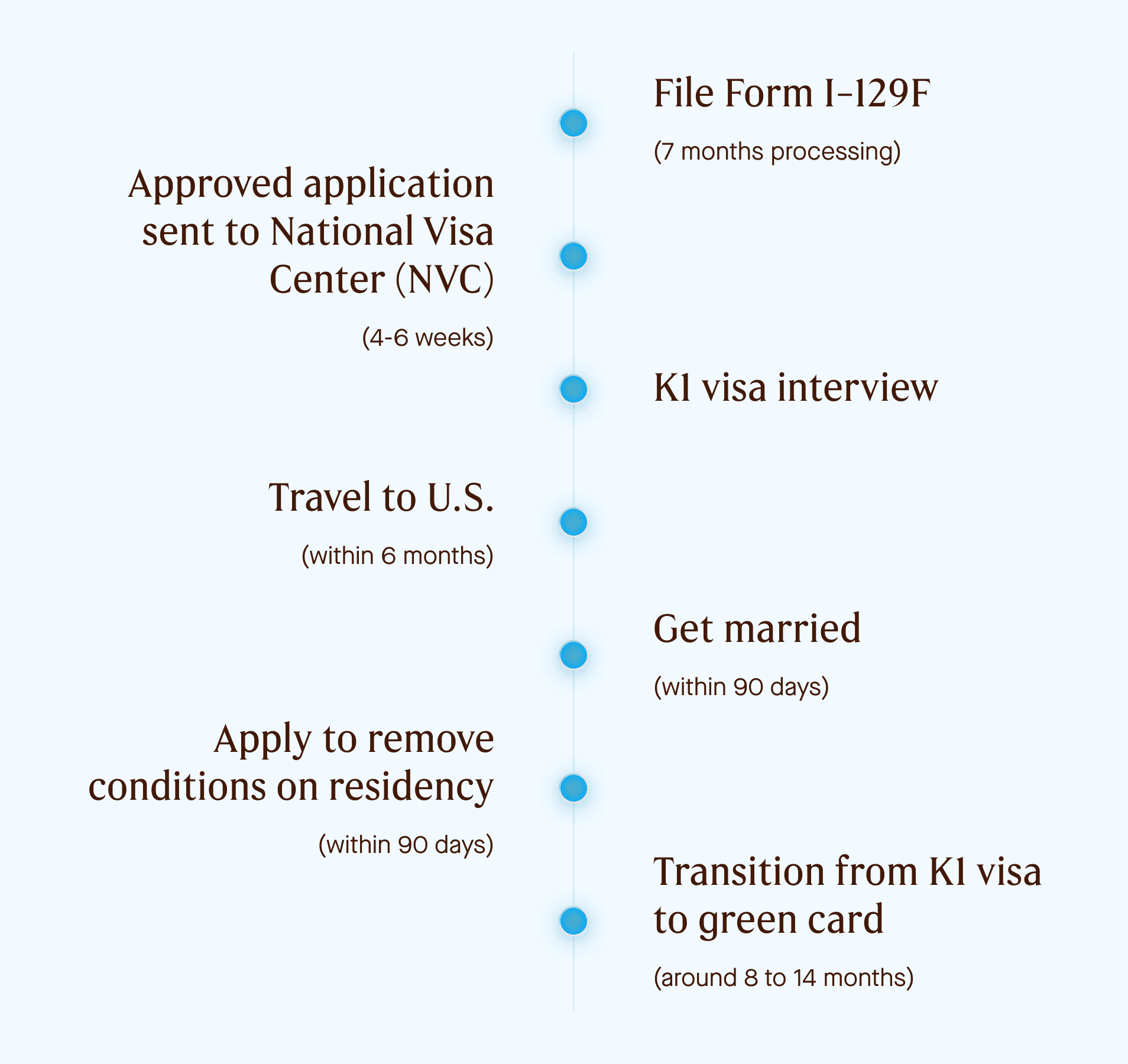
The K1 visa process starts with the U.S. citizen sponsor filing a Petition for Alien Fiancé(e) (Form I-129F) with USCIS. Form I-129F declares your intention to marry your foreign fiancé(e) and bring them to the U.S.
After filing, you wait for USCIS to approve your petition. Once approved, it moves to the National Visa Center (NVC) and eventually to the U.S. embassy or consulate in your fiancé(e)'s country.
Next, the fiancé(e) completes the application forms and attends a K-1 visa interview at the U.S. embassy or consulate in their home country, providing necessary documents and undergoing a medical check-up.
If approved, the foreign fiancé(e) will receive a K-1 visa in their passport, allowing them to travel to the U.S. Within six months, they must enter the U.S. to begin the process.
Once in the U.S., you both have 90 days to get married. Remember, this is a crucial step! Failure to marry within this timeframe could result in the foreign fiancé(e) having to leave the country.
After marriage, your spouse can apply for adjustment of status via Form I-485 to become a lawful permanent resident and secure a Green Card.
If your marriage is less than two years old when the green card is issued, your spouse will need to apply to remove conditions on their residency within the 90-day period before their green card expires.
After successfully completing the adjustment of status process – including the removal of conditions, if applicable! – the foreign spouse will receive green card status, allowing them to live and work permanently in the U.S.
Subscribe to our newsletter for immigration resources and news-without the legal jargon.
Getting ready for your K1 visa interview is one of the most important steps of the process! But don’t stress – we’re going to share what you can expect to happen during the interview and offer some expert tips to prepare for it.
First, you will receive notification of your interview date, time, and location from the U.S. embassy or consulate where the interview will take place.
Once the interview date is confirmed, get your documents together! You will want to make sure that you have all your documents ready for the K1 interview, including:
Passports
Birth certificates
Medical examination results
Financial support documents
Evidence of your relationship
Tip: When you arrive at the embassy or consulate for your interview, be there early. You might need to leave certain items outside, so plan accordingly.
Typically, the K1 interview takes place at either a desk or window with a consular officer. The officer will first verify your identity, then dive into questions about your relationship with your fiancé(e), your plans for marriage, and your intentions in the U.S.
You will also need to provide evidence of your relationship, like photos, emails, letters, and any other documentation that proves the authenticity of your relationship.
You might also be asked about your ability to support yourself and your fiancé(e) in the United States. Make sure you have documentation to prove that you meet the K-1 visa financial requirement.
How long is the K-1 visa interview? On average, the K-1 interview typically lasts around 15 to 30 minutes .
Some interviews might be quick and straightforward, while others might take a bit longer depending on your situation. But no matter how long it takes, staying calm, collected, and confident during the interview is your best bet for making a good impression and boosting your chances of getting the K1 visa approved.
And, if English isn't your first language, make sure to prepare yourself and practice your responses beforehand. The interview will likely be in English, and you will need to be able to communicate effectively with the consular officer.
Tip: Remember to remain calm and composed during the interview, and answer all questions truthfully and to the best of your ability. Preparation and organization are key!
At the end of the interview, the officer will let you know if your K1 visa is approved or denied.
If it's approved, you'll get instructions on what to do next. You'll likely need to submit more paperwork and attend another appointment before you can get your K1 visa and travel to the U.S.
The questions asked during a K-1 visa interview are designed to assess the genuineness of your relationship and your intention to get married in the U.S.
Make sure to answer them truthfully and have any supportive documentation that can support your answers.
Let’s take a look at some of the most common K-1 visa interview questions :
How did you and your fiancé(e) meet?
When and where did you first meet in person?
Can you describe your relationship history and how it has developed?
How long have you been in a relationship with your fiancé(e)?
Have you met each other's families? If yes, can you provide details?
Can you describe your fiancé(e)'s personality and interests?
What are your plans for your wedding ceremony?
Where do you intend to live in the United States after marriage?
Can you provide details about your fiancé(e)'s previous marriages, if any?
How do you communicate with your fiancé(e) when you are apart?
Have you ever lived together? If not, do you have plans to live together before marriage?
Can you describe your fiancé(e)'s daily routine and habits?
What are your fiancé(e)'s career aspirations and employment history?
Have you discussed any cultural or religious differences between you and your fiancé(e)?
How do you plan to support yourselves financially in the United States?
Getting ready for the K1 interview soon? We've put together this checklist to help you feel prepared and confident for your big day. Download the PDF and print it out.
K-1 visa processing time in 2025 is approximately 10 months (for Form I-129F), according to USCIS's most recent data from November 2025.
After USCIS approves Form I-129F, your case will be sent to the National Visa Center (NVC), which usually takes about four to six weeks .
It's important to remember that these timelines can vary based on your specific situation and how busy USCIS and the NVC are at the time. To stay updated, check the official USCIS and Department of State websites regularly.
Government fees to apply for a K-1 visa are $675, and the cost to get a green card after you are married can be up to $3,000.
It’s important to know there are multiple fees associated with your K1 visa application:
K1 visa lawyer fees
K1 visa cost
Additional costs
Lawyer fees for a K1 visa can vary significantly depending on which lawyer you choose. If you’re looking for a more individualized approach, we recommend going with a smaller law firm that specializes in K1 visa cases (like us!).
Here at Keller Law, our K1 visa lawyer fees start at $3,500 and come with "Visa Approved or Money Back" guarantee ( terms apply ).
Below is a breakdown of the fees associated with the K1 visa:
Government fee
Form I-129F
DOS Visa Fee
Cost
$675
$265
Keller Law©️.
The government's fee for Form I-129F is $675, payable via credit card using Form G-1450 or ACH. Note that as of November 2025, USCIS has phased out checks and money orders , with limited exceptions.
Tip: If you file Form I-129F online, you qualify for a $50 discount!
The K-1 visa application fee (DOS visa fee) is $265, usually paid at the interview. Specific payment instructions will be provided in the embassy's interview notice, which can vary by home country.
Filing fees are subject to change. Always check USCIS's official Fee Schedule for the most up-to-date information on K-1 visa government fees.
Request an evaluation
Discuss the visa options of interest to you
General information about timelines, fees, requirements for various visa options
Information on Keller fees, terms and process
Full clarity and transparency every step along the way
Request a consultation
Avi Goldenberg
Principal attorney at Keller Law, PLLC
In this blog article:
What is a K1 visa?
What are the benefits of the K1 visa?
K1 visa requirements
What is the K1 visa income requirement?
Proving your relationship for the K1 visa
K1 visa proof of relationship examples
K1 visa approval rate by country
K1 visa timeline
Step-by-step: K1 visa process
What to expect during the K1 visa interview
K1 visa interview questions
K1 visa interview checklist
K1 visa processing time 2024
How much is a K1 visa?
Frequently asked questions
Schedule Your Free Discovery Call
Take the first step toward resolving your legal challenges. Book a friendly meet-and-greet to get to know each other (no legal advice at this stage). However, if you’re ready for tailored guidance, schedule a direct legal consultation instead.
We’re here to support you every step of the way!
Get in Touch with Us
300 Main Street, 1st Floor Worcester, MA 01608


Monday - Friday | 9AM to 5PM
Saturday | Appointment Only
Sunday | Closed
Disclaimer:
In accordance with rules established by the Supreme Judicial Court of Massachusetts, this site must be labeled “advertising.” It is designed to provide general information for clients and those browsing our firm’s website and should not be construed as legal advice, or legal opinion on any specific facts or circumstances. This website is designed for general information only. The information presented at this site should not be construed to be formal legal advice nor the formation of a lawyer/client relationship.



Powered by AG InfoTech