Call Us NowEmail Us Now

Back to All Blogs

blog-authorDavid A. Keller, Esq.

Hero Image

In Removal Proceedings? What to Do After a Notice to Appear
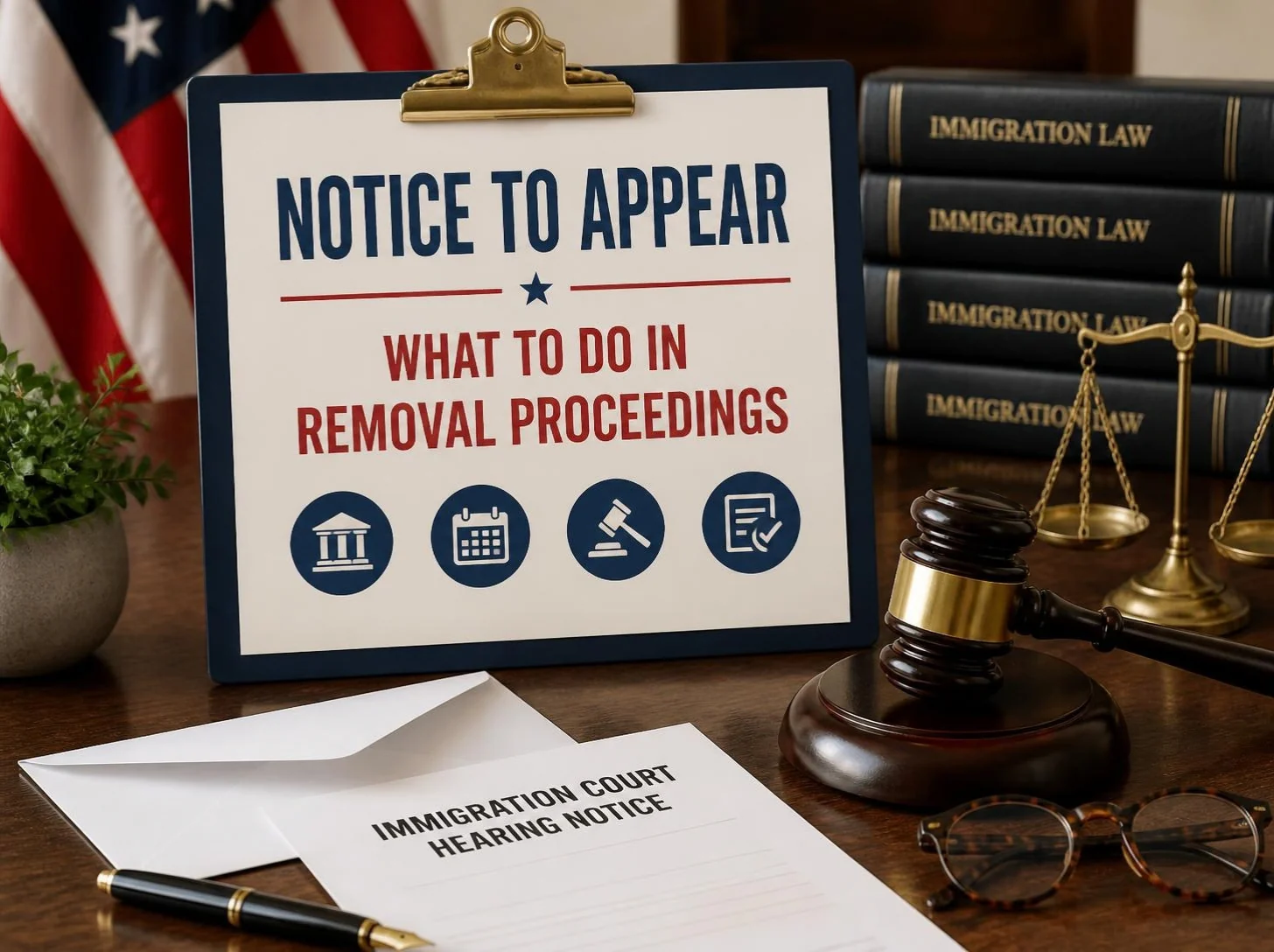
Immigration court hearing notice, gavel, and Notice to Appear guide on an attorney's desk
Few pieces of mail cause as much fear as a Notice to Appear. It is the document that starts removal proceedings, the formal process the government uses to try to deport someone. But a Notice to Appear is not a deportation order, and receiving one does not mean your case is lost. People in removal proceedings win asylum, obtain green cards, and have their cases closed every day.

What you do in the first few weeks matters a great deal. This guide walks through the steps we urge every client to take, what happens in immigration court, and the defenses that may be available.

What Removal Proceedings Actually Are

Removal cases are heard by immigration judges in the Executive Office for Immigration Review (EOIR), which is part of the Department of Justice. That makes the court separate from USCIS and ICE, which both belong to the Department of Homeland Security (DHS). In court, a DHS attorney argues the government’s side.

Most cases begin with Form I-862, Notice to Appear (NTA). The NTA lists the government’s factual allegations about you, such as your citizenship and how you entered the country, along with the legal charges it says make you removable. It is a charging document, not a judgment. The case formally begins only when DHS files the NTA with the immigration court.

Your First Steps After Receiving an NTA

1. Keep everything. Save the NTA, the envelope it came in, and every letter you receive from the immigration court, ICE, or USCIS.

2. Find your A-number. Your Alien Registration Number is usually printed on the NTA. It is an 8- or 9-digit number that starts with the letter “A.” If you cannot find it, our guide on how to find your A-number can help.

3. Confirm your hearing. Look up your case online or by phone (details below) so you know the date, time, and court location.

4. Read the NTA carefully. Check your name, date of birth, country, address, the factual allegations, and the charges. If anything is wrong, tell your attorney. Do not agree to it in court.

5. Make sure the court has your current address. Court notices go only to the address the court has on file.

6. Speak with an immigration attorney before your first hearing if at all possible. What you say at that hearing can shape the rest of your case.

How to Check Your Immigration Court Case

EOIR’s Automated Case Information portal lets you look up your case by entering your A-number without the letter “A.” You can also call the automated hotline at 1-800-898-7180. Either one can show your next hearing date, the court’s address, and other case details.

If your case does not show up, do not assume it went away. DHS sometimes serves an NTA before filing it with the court. Keep checking, watch your mail for a Notice of Hearing, and follow the dates on any court papers you receive, even if the online system shows nothing.

The same goes for an NTA that lists no hearing date or says the date is “to be set.” You are still in proceedings. The court will mail a separate hearing notice, so keep checking the system and keep your address up to date.

Moving? Tell the Court Within Five Days

If your address or phone number changes, you must notify the immigration court within five working days using Form EOIR-33/IC. A missed notice sent to an old address is one of the most common ways people end up with a removal order they never saw coming.
  • USCIS is not the court — updating your address with USCIS (Form AR-11) does not update it with the immigration court. They are separate agencies, so file both. Our AR-11 guide explains the USCIS side.
  • Your case doesn’t move with you — relocating to another state does not transfer the case. You must ask the judge to change venue, and you must keep attending your scheduled hearings unless the judge grants the request.

Never Miss a Hearing

If you do not appear, the judge can order you removed in absentia, meaning in your absence. An in absentia order can also bar you for 10 years from several important forms of relief, including cancellation of removal, voluntary departure, and adjustment of status.
  • Asking to reschedule doesn’t cancel the hearing — until the judge grants your request, plan to be there.
  • Arrive early — bring your ID and court papers, and expect a security screening.
  • If you already missed a hearing — check your case status right away and call an attorney. A motion to reopen may be possible, generally within 180 days if exceptional circumstances such as a serious illness kept you away, or at any time if you never received proper notice. The rules depend on why the hearing was missed, so act quickly.

Your First Hearing: The Master Calendar Hearing

Your first court date is usually a master calendar hearing. It is short and procedural, and the judge often hears many cases in the same session. It is not where the case is decided. At this hearing, the judge may:
  • Explain your rights and the government’s charges
  • Confirm whether the information in the NTA is correct
  • Ask whether you admit or deny the allegations and charges
  • Ask what form of relief you plan to apply for
  • Set deadlines for applications and evidence
  • Schedule your next hearing

Your answers carry real consequences, so try to have a lawyer before you respond to the charges. You have the right to an attorney, but the government will not provide or pay for one. If you are still looking, you can ask the judge for more time. The judge does not have to grant it, so keep a record of every attorney or organization you contacted. EOIR also publishes a list of free legal service providers.

If you are not comfortable in English, tell the court which language you speak best. The court provides interpreters at no cost.

The Individual Hearing: Where Your Case Is Decided

The individual hearing (also called a merits hearing) is your trial. You can testify, call witnesses, and submit documents. The DHS attorney can cross-examine you and present the government’s evidence. The judge may decide at the end of the hearing or issue a written decision later.

Judges set strict filing deadlines before this hearing, and late evidence can be excluded. If the decision goes against you, it can generally be appealed to the Board of Immigration Appeals within 30 days.

Documents to Start Gathering Now

  • The NTA and every notice from the immigration court
  • All paperwork from ICE and USCIS, including approval and denial notices
  • Passports, visas, identity documents, and your I-94 record
  • Copies of any immigration applications you have filed before
  • Birth, marriage, and divorce certificates, including your children’s
  • Proof of where you have lived and worked over time, such as leases, tax returns, and pay stubs
  • Certified court records for every arrest or criminal case, even cases that were dismissed
  • Evidence of fear of returning to your home country, abuse, crime victimization, trafficking, or serious medical conditions, if they apply to you

One caution: gather these documents, but do not file them with the court on your own. Some may not help your case, others need certified translations, and every filing has its own rules and deadlines. Let your attorney decide what to submit and when.

Can You Fight Removal? Common Forms of Relief

In many cases, yes. Depending on your history and circumstances, you may be able to pursue:
  • Asylum, withholding of removal, or protection under the Convention Against Torture — for people who fear persecution or torture if returned. Asylum generally must be requested within one year of arrival, with limited exceptions. Learn more on our asylum page.
  • Cancellation of removal for permanent residents — generally requires at least five years as a green card holder, seven years of continuous residence after admission, and no aggravated felony conviction.
  • Cancellation of removal for non-permanent residents — generally requires ten years of continuous physical presence, good moral character, no disqualifying convictions, and proof that removal would cause exceptional and extremely unusual hardship to a U.S. citizen or permanent resident spouse, parent, or child.
  • VAWA cancellation of removal — for certain survivors of abuse by a U.S. citizen or permanent resident spouse or parent.
  • A green card through family or employment — in some cases, adjustment of status can be pursued while removal proceedings are pending.
  • U and T visas — for victims of certain crimes and of human trafficking.
  • Challenging the charges — if the government’s allegations are wrong or the charges cannot be proven, the case may be terminated.
  • Voluntary departure — when no other relief is available, leaving on your own terms can avoid some of the long-term consequences of a removal order.

Keep in mind that a pending application with USCIS does not automatically stop your court case. Both need to be managed together, ideally by the same attorney.

If ICE Detains You or a Family Member

  • Share key details — make sure a trusted person knows your full name, country of birth, A-number, and where you are being held.
  • Locate the person — family members can use ICE’s Online Detainee Locator System with the A-number, or with the person’s name and country of birth.
  • Ask about release — an attorney can evaluate whether a bond hearing or another form of release is possible. Not everyone qualifies, and the rules on who does have shifted under recent government policy and litigation.
  • Don’t sign what you don’t understand — some documents offered in detention can waive your right to see a judge.

Detained cases move much faster than cases on the regular docket, so call a lawyer immediately.

Mistakes That Can Cost You Your Case

  • Ignoring an NTA because it has no court date
  • Missing a hearing for any reason
  • Moving without notifying the court
  • Assuming a request to reschedule means you don’t have to appear
  • Admitting the NTA’s allegations without fully understanding them
  • Filing documents without checking the rules and deadlines
  • Assuming a pending USCIS case pauses the court case
  • Leaving the United States without understanding how it affects your case

Frequently Asked Questions

Is a Notice to Appear the same as a deportation order?
No. The NTA is the charging document that starts the case. Only an immigration judge can order you removed, and that has not happened just because you received an NTA.

What if I can’t find my case online?
Keep checking and watch your mail. The case may not appear until DHS files the NTA with the court and a hearing is scheduled.

Can I ask for more time to find a lawyer?
Yes, you can ask, but the judge does not have to agree. Bring a list of the attorneys and legal organizations you have contacted to show you have been trying.

How long will my case take?
There is no standard timeline. Some cases are resolved in months, while others take years, especially in busy courts. Follow the dates on your own court papers.

Can I travel outside the U.S. while my case is pending?
Not without talking to an attorney first. Leaving can end your case in ways you do not intend and can trigger bars to returning.

Facing Immigration Court? Talk to Keller Law Group

You do not need to understand every part of immigration court before asking for help. Start by protecting your documents, confirming your next hearing, and finding out which defenses may apply to you. Then let an experienced attorney handle the rest.

At Keller Law Group, LLC, we represent individuals and families in removal proceedings, from the first master calendar hearing through the final decision, and we move quickly when a loved one has been detained by ICE.

Schedule a consultation today.
Keller Law Group, LLC
Phone: (857) 810-8040
Email: info@kellerimmigration.com

This article provides general information, not legal advice about your specific situation.
Hero Image

About Keller Law Group, LLC

Keller Law Group, LLC specializes in immigration law, criminal defense, and personal injury cases. With a commitment to excellence and personalized service, we are here to guide you through every step of the legal process. Visit www.kellerimmigration.com to learn more

Schedule Your Free Discovery Call

Take the first step toward resolving your legal challenges. Book a friendly meet-and-greet to get to know each other (no legal advice at this stage). However, if you’re ready for tailored guidance, schedule a direct legal consultation instead.
We’re here to support you every step of the way!

Schedule Legal Consultation

Connect With Us on Instagram

swiper-image
swiper-image
swiper-image
swiper-image
swiper-image
swiper-image
swiper-image
swiper-image
swiper-image
swiper-image
swiper-image
swiper-image
swiper-image
swiper-image
swiper-image
iphone
View More

We’re Here to Help

Get in Touch with Us

300 Main Street, 1st Floor Worcester, MA 01608

google-maps-logo
Logo

Monday - Friday | 9AM to 5PM

Saturday | Appointment Only

Sunday | Closed

Disclaimer:

In accordance with rules established by the Supreme Judicial Court of Massachusetts, this site must be labeled “advertising.” It is designed to provide general information for clients and those browsing our firm’s website and should not be construed as legal advice, or legal opinion on any specific facts or circumstances. This website is designed for general information only. The information presented at this site should not be construed to be formal legal advice nor the formation of a lawyer/client relationship.

Icon 1Icon 2Icon 3Icon 4Icon 5Icon 6

Powered by AG InfoTech