Call Us NowEmail Us Now

Back to All Blogs

blog-authorDavid A. Keller, Esq.

Hero Image

Can You Sponsor Your Own O-1 Visa? What Founders Need to Know
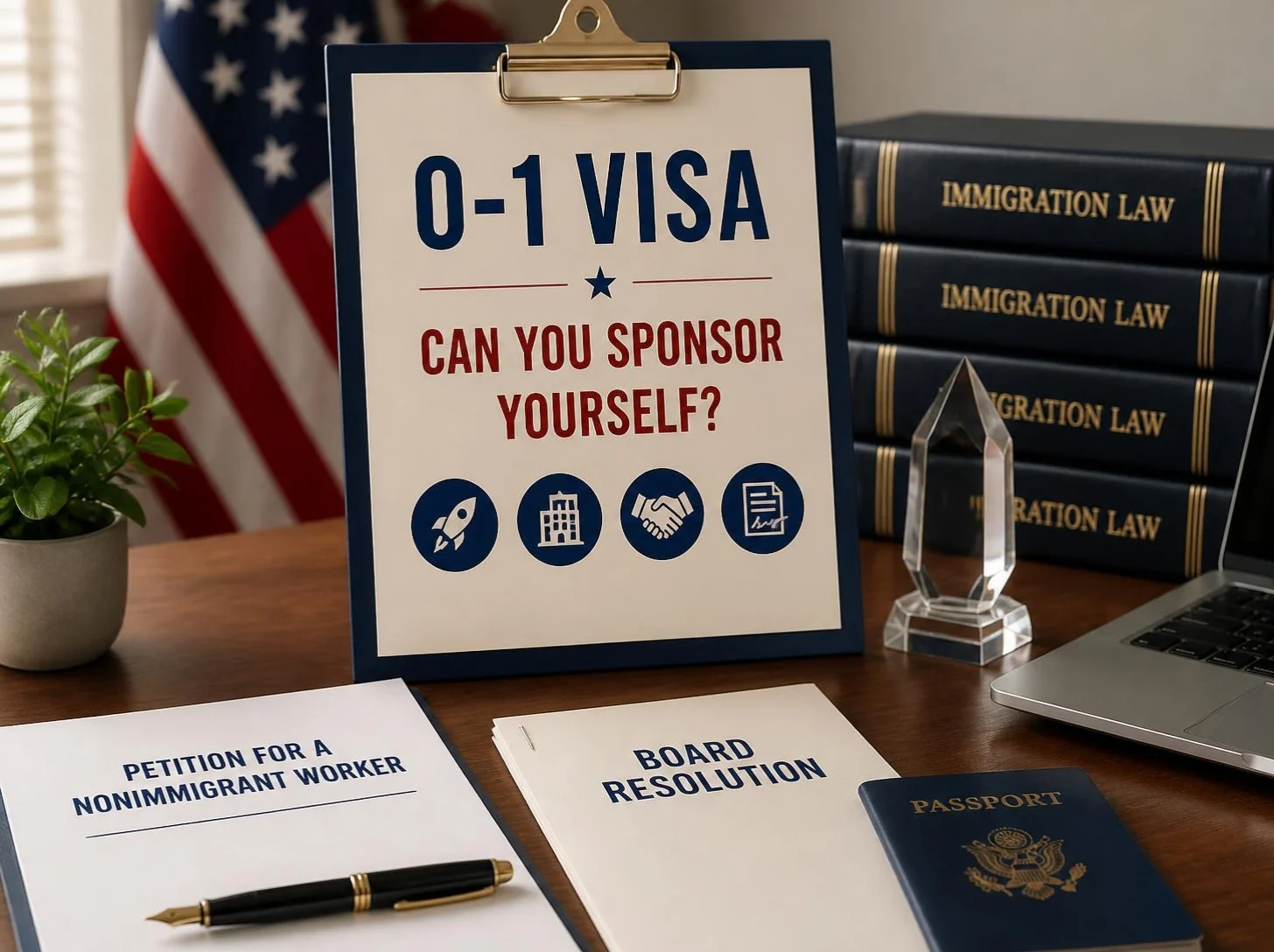
O-1 visa petition, board resolution, and award on an immigration attorney's desk
It is a question we hear often from founders: “I have the press, the awards, and the investors. Can I just sponsor my own O-1?”

The answer comes in two parts. You cannot file an O-1 petition for yourself. But a company you own, or a U.S. agent, can file it on your behalf, and that is exactly how many founders and entrepreneurs get their O-1 approved. Whether it works for you usually turns on a question most applicants never think about until a Request for Evidence arrives: who is the petitioner, and does anyone besides you have real authority over your work?

Why You Can’t Self-Petition for an O-1

Every O-1 case is filed on Form I-129, Petition for a Nonimmigrant Worker, by a U.S. employer or a U.S. agent. The regulations are blunt about it: an O-1 beneficiary may not petition for himself or herself (8 C.F.R. § 214.2(o)(2)(i)).

Pay attention to what that rule actually covers. It controls who files the petition, not who you work for, and nothing in it stops you from working for a company you founded. Founders usually run into trouble in one of two ways. Some read “no self-petitions” as “no self-employment” and give up on a visa they could have had. Others file through a company they control so completely that USCIS cannot find a real employer behind it.

Option 1: Your Own Company Files the Petition

A U.S. corporation or LLC is a legal entity separate from its owners, so a company you founded can act as your O-1 employer. USCIS accepts that arrangement when the company is a real, operating business and a real employer, not a stand-in for you.
  • Best fit — you work mainly for one company, ideally one with outside investors, co-founders, or an active board.
  • What the petition must show — the company is properly formed, actively doing business, and has genuine authority to hire, supervise, pay, and fire you.
  • Key documents — formation records, the cap table, governance documents and board resolutions, and your employment agreement.
  • The trade-off — your O-1 is tied to that company. If it closes or you leave, you will need a new petition from a new employer or agent.

The type of entity matters. A C-corporation with a board of directors usually tells the cleanest story, because the board is a decision-maker that exists apart from you. A single-member LLC is not automatically disqualified, but expect closer scrutiny. When one person holds every seat, it is hard to show that anyone else is in charge.

Option 2: A U.S. Agent Files the Petition

The O-1 rules also allow a U.S. agent to file for people who are traditionally self-employed, who use agents to arrange work with several employers, or whose foreign employer has authorized an agent to act for it (8 C.F.R. § 214.2(o)(2)(iv)(E)).
  • Best fit — founders who own all or nearly all of their company, very early-stage startups without a board, and anyone splitting time between their own venture and advisory, consulting, or speaking work.
  • What the petition must show — a genuine agency arrangement, a complete itinerary listing the dates, employers, and locations of each engagement, the contracts with those employers, and an explanation of the terms and conditions of the work.
  • Key documents — the agent agreement, the itinerary, and the employer contracts.
  • The trade-off — more paperwork up front, but your status is not tied to the fortunes of a single startup.

As a rule of thumb, a company petition makes sense when there are outside investors, a functioning board, and one primary role. An agent is usually the better choice for controlling owners, early-stage companies, and founders whose time is divided across several projects.

The Real Test: Could Anyone at the Company Fire You?

When your own company is the petitioner, the officer will look past the corporate paperwork to a practical question: can someone at this company credibly supervise you, set your pay, and end your employment? If the honest answer is no, the “employer” is really just you under another name, and the petition risks being treated as a self-petition.

These are the documents that answer that question well:
  • Formation records — articles of incorporation or organization, the EIN, a U.S. business address, and proof the business actually operates, such as bank statements, client contracts, payroll, or revenue.
  • Cap table — every shareholder and their ownership percentage, including outside investors and co-founders.
  • Governance documents — bylaws or an operating agreement, plus board resolutions that give the board authority over hiring, supervision, compensation, and termination, including yours.
  • Board roster — at least one director who is not under your control.
  • Employment agreement — signed for the company by someone other than you, setting out your duties, compensation, and termination terms.
  • Proof the board actually functions — minutes, written consents, and reports showing it reviews performance and makes real decisions.

Mistakes That Sink Founder O-1 Petitions

When a founder’s O-1 runs into trouble, the cause is often structural rather than a lack of achievements:
  • Filing through a 100%-owned company with no outside governance. If you are the only shareholder, director, and officer, nobody can supervise or terminate you. Unless real governance is put in place first, an agent is usually the safer petitioner.
  • Governance that appears the week before filing. Bylaws, board appointments, and an employment agreement all dated days before the petition look like they were created for USCIS, because they were. A track record of minutes, resolutions, and decisions the board has actually made carries far more weight.
  • Building the evidence before choosing the petitioner. The petitioner determines which contracts, itineraries, and governance documents the case needs. Settle the structure first, then build the record around it.
  • Signing your own employment agreement. If you sign for the company that is supposed to supervise you, you undercut the very point the petition has to prove. Another officer or a board member should sign.

You Still Have to Qualify for the O-1 Itself

Choosing the right petitioner solves only half of the case. The other half is proving that you meet the O-1 standard. For the O-1A (sciences, education, business, and athletics), that means sustained national or international acclaim, shown either by a major, internationally recognized award or by evidence that meets at least three of these criteria:
  • Nationally or internationally recognized prizes or awards
  • Membership in associations that require outstanding achievement
  • Published material about you in professional publications or major media
  • Judging the work of others in your field
  • Original contributions of major significance
  • Authorship of scholarly articles
  • A critical or essential role at an organization with a distinguished reputation
  • A high salary compared with others in your field

The petition also needs a written advisory opinion (often called a consultation letter) from an appropriate peer group, labor organization, or expert in your field. If approved, an O-1 can be granted for up to three years at first, with extensions available in one-year increments. For a deeper look at the evidence, see our complete O-1 visa guide.

Frequently Asked Questions

Can I be the sponsor on my own O-1 petition?
No. The petition has to come from a U.S. employer or a U.S. agent. When founders talk about “self-sponsoring,” what they really mean is that a company they own files the petition as their employer.

Does my company have to be the petitioner?
No. A U.S. agent can file instead, and that is often the better route for founders who control their company outright or work on more than one venture.

Can my own LLC act as my agent?
An LLC you own can file as your employer. Acting as an agent for other companies is different: the LLC would need authorization from those companies and would have to genuinely operate as an agent. If you fully control the LLC, USCIS may treat the filing as a self-petition, so this setup needs careful planning.

What happens to my O-1 if my startup shuts down?
Your status is tied to the petitioner. If the employment ends, O-1 workers generally have a grace period of up to 60 consecutive days (or until their authorized stay ends, if sooner) to find a new petitioner, change status, or prepare to depart. To keep working, you will need a new O-1 petition from a new employer or agent.

Do I need outside investors?
Not strictly. But outside owners and an independent board make it far easier to show that someone other than you controls your employment. Without them, an agent-filed petition is often the cleaner option.

Planning an O-1 for Your Startup? Talk to Keller Law Group

The strongest founder O-1 cases are built in the right order: choose the petitioner, put real governance in place, then assemble the extraordinary-ability evidence on top of that foundation. Getting the order wrong is one of the most common reasons otherwise accomplished founders end up facing an RFE or a denial.

At Keller Law Group, LLC, we help founders and entrepreneurs decide between company and agent petitions, document genuine employer authority, and prepare O-1 evidence that holds up under USCIS review.

Schedule a consultation today.
Keller Law Group, LLC
Phone: (857) 810-8040
Email: info@kellerimmigration.com
Hero Image

About Keller Law Group, LLC

Keller Law Group, LLC specializes in immigration law, criminal defense, and personal injury cases. With a commitment to excellence and personalized service, we are here to guide you through every step of the legal process. Visit www.kellerimmigration.com to learn more

Schedule Your Free Discovery Call

Take the first step toward resolving your legal challenges. Book a friendly meet-and-greet to get to know each other (no legal advice at this stage). However, if you’re ready for tailored guidance, schedule a direct legal consultation instead.
We’re here to support you every step of the way!

Schedule Legal Consultation

Connect With Us on Instagram

swiper-image
swiper-image
swiper-image
swiper-image
swiper-image
swiper-image
swiper-image
swiper-image
swiper-image
swiper-image
swiper-image
swiper-image
swiper-image
swiper-image
swiper-image
iphone
View More

We’re Here to Help

Get in Touch with Us

300 Main Street, 1st Floor Worcester, MA 01608

google-maps-logo
Logo

Monday - Friday | 9AM to 5PM

Saturday | Appointment Only

Sunday | Closed

Disclaimer:

In accordance with rules established by the Supreme Judicial Court of Massachusetts, this site must be labeled “advertising.” It is designed to provide general information for clients and those browsing our firm’s website and should not be construed as legal advice, or legal opinion on any specific facts or circumstances. This website is designed for general information only. The information presented at this site should not be construed to be formal legal advice nor the formation of a lawyer/client relationship.

Icon 1Icon 2Icon 3Icon 4Icon 5Icon 6

Powered by AG InfoTech